What is an ultrasonic probe sonicator?
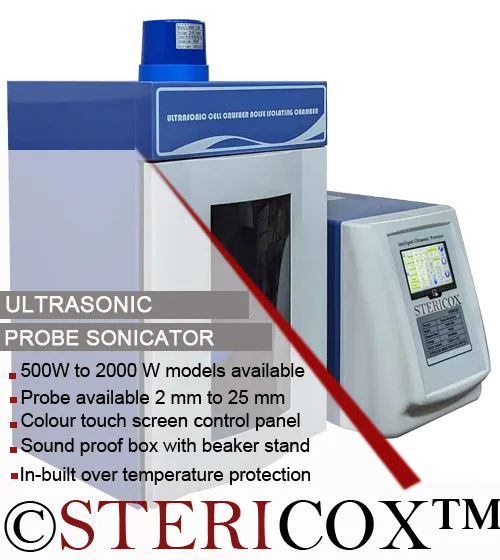
A probe sonicator is a lab instrument that uses high-frequency sound waves to break apart, mix or disperse the material in a liquid sample. You'll also hear it called an ultrasonic homogenizer, ultrasonic cell disruptor, ultrasonic cell crusher or tissue disruptor. They're all the same family of instrument.
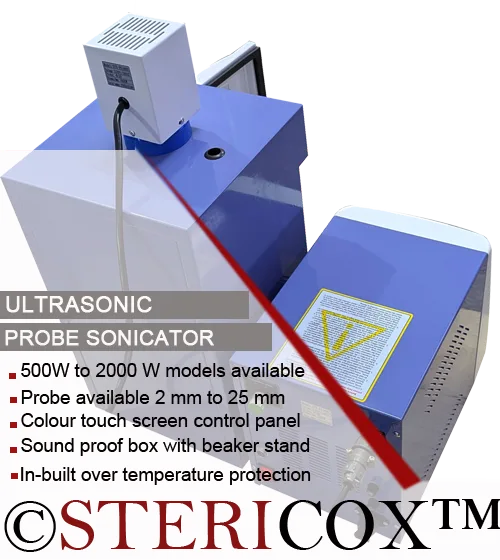
A complete system has three parts:
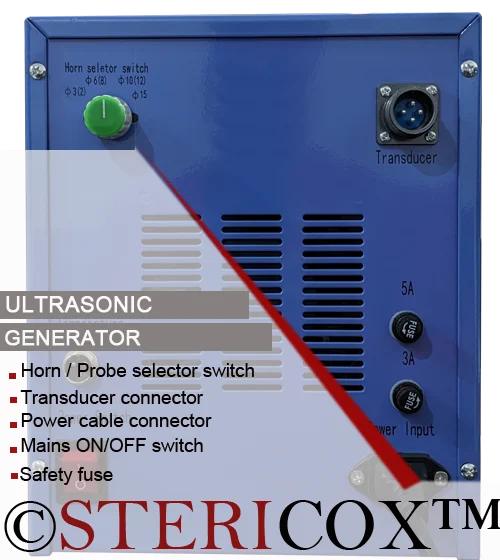
- Generator: turns mains power into a high-frequency electrical signal.
- Converter (transducer): changes that signal into tiny mechanical vibrations.
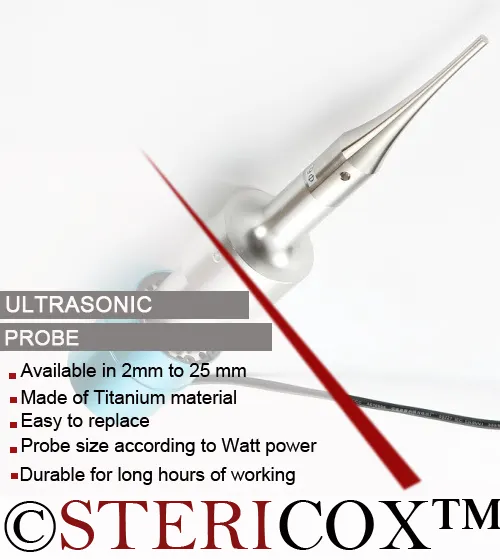
- Probe (horn): carries the vibrations into your sample. The probe size you pick decides how much liquid you can treat.
How does probe sonicator work?
The probe vibrates thousands of times a second inside your liquid. That creates millions of microscopic bubbles which grow and then collapse violently, a process called cavitation. Each collapse sends out a tiny shock wave and a micro-jet of liquid. Together, they tear cell walls open, break up clumps of particles and blend liquids that don't normally mix.
The result: fast cell lysis, finer particle sizes and smoother, more stable emulsions.
Probe sonicator Applications
The primary uses of ultrasonic probe sonicators are in laboratories and industries, including research labs, pharmaceutical R&D, biotechnology, food testing, and materials science. Teams in these fields all use probe sonicators. Below are some applications:
- Cell lysis and tissue homogenization: breaking open bacteria, yeast, plant and animal cells to release proteins, DNA and RNA.
- Nanoparticle dispersion: getting nanoparticles evenly suspended without clumps.
- Emulsification: creating fine, stable emulsions for pharma, cosmetics and food samples.
- Extraction: pulling active compounds out of plant material and other solids.
- Degassing and mixing: removing dissolved gases and blending samples quickly.
- Accelerating chemical reactions: where mixing and energy input make a difference.
Probe sonicator vs ultrasonic cleaner: which do you need?
| Probe sonicator | Ultrasonic cleaner (bath) | |
|---|---|---|
| How energy reaches the sample | Directly, through a probe dipped into the liquid | Indirectly, through the tank and sample container |
| Intensity | Very high and focused | Mild and spread out |
| Best useful for | Cell disruption, nanoparticle dispersion, emulsification, homogenizing | Cleaning glassware and parts, degassing solvents |
| Control parameters | Amplitude 1–100%, pulse ON/OFF, timer | Usually timer and heater only |
NOTE: For nanoparticle work and cell disruption, a probe sonicator is the better choice. If you mainly clean instruments or degas solvents, an ultrasonic cleaner is the right tool.
FEATURES & BENEFITS
- Models available in 500W, 650W, 900W, 1200W, 1800W & 2000W
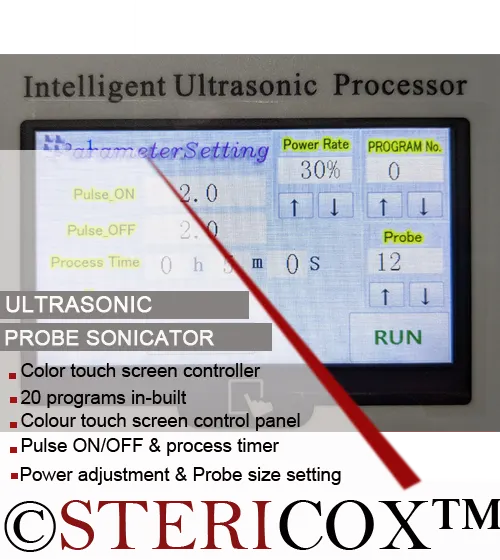
- Colour touch screen controller with simple menus. Simple menu driven color touch screen control panel for easy operation, just set parameters and run the machine.
- 20 programs storage: There are up to 20 programs can be stored. Set different parameters and save them as a program and run the same protocol again with one touch.
- Amplitude control from 1% to 100%. Go gentle for delicate samples or full power for tough ones. (suggested to operate below 100% amplitude and keep high Pluse ON/OFF time for safe operation)
- Adjustable pulse ON/OFF. Pulse ON/OFF timer keeps your sample cool and protect heat-sensitive material. (suggested longer Pulse OFF time at high amplitude)
- Over temperature safety probe. PT100 temperature sensor probe is provided to dip in the sample which allows control panel to stop processing if sample is over heated.
- Password-protected access. Password protection keeps instrument safe from unauthorized access.
- Built-in alarms for faults, temperature and timer.
- Interchangeable probes. Probes provided with the instrument are interchangeable; the spanner is included for quick and easy replacement.
Our probe sonicator range
There are six models to choose from, ranging from 500 Watt to 2000 Watt and designed for different sample volumes. When selecting the suitable model, simply check the required sample processing volume.
| Ready In Stock Probe Sonicator Models | |||||
| Model | Frequency | Power | Processing volume | Standard probe | Optional probes (mm) |
|---|---|---|---|---|---|
| STXPS500 | 20 - 25 Khz | 0 – 500 W | 0.1 – 400 ml | 6 mm | 2 |
| STXPS650 | 20 - 25 Khz | 0 – 650 W | 0.1 – 500 ml | 6 mm | 2, 3 |
| STXPS900 | 20 - 25 Khz | 0 – 900 W | 0.1 – 600 ml | 12 mm | 2, 3, 10 |
| STXPS1200 | 19.5 - 20.5 Khz | 0 - 1200 W | 0.1 – 1200 ml | 15 mm | 10, 20 |
| STXPS1800 | 19.5 - 20.5 Khz | 20 – 1800 W | 10 – 1500 ml | 20 mm | 10, 15 |
| STXPS2000 | 19.5 - 20.5 Khz | 20 – 2000 W | 10 – 1800 ml | 25 mm | 10, 15, 20 |
TECHNICAL SPECIFICATIONS
| Common Specifications For All The Models | |
| Control panel |
|
| Temperature control | Sample safety temperature probe |
| Timing | 0 - 99H59M59S (adjustable) |
| Pulse | 0.1 - 99.9s adjustable (interval/working) |
| No. of programs stored | 20 nos. programs storage |
| Alarm | Fault, Temperature and Timer |
| Accessories |
|
| Safety |
|
| Power supply | 220V/50Hz Single Phase |
Choosing the right probe (horn) size
| PROBE SIZE | FREQUENCY | POWER RANGE | CRUSHING CAPACITY | |
|---|---|---|---|---|
| mm | Inch | |||
| 2 | 1/12 | 20 - 25KHz | min - 150W | 0.2 - 5 mL |
| 3 | 1/8 | 20 - 25KHz | min - 250W | 3 - 10 mL |
| 6 | ¼ | 20 - 25KHz | 20 - 400W | 10 - 100 mL |
| 10 | 5/12 | 20 - 25KHz | 100 - 600W | 30 - 300 mL |
| 12/13 | ½ | 20 - 25KHz | 200 - 900W | 50 - 500 mL |
| 15 | 5/8 | 20 - 25KHz | 300 - 1000W | 100 - 600 mL |
| 20 | 4/5 | 19.5 - 20.5KHz | 400 - 1000W | 100 - 1000 mL |
| 25 | 1 | 19.5 - 20.5KHz | 800 - 1500W | 500 - 1200 mL |
NOTE: Above table is for reference only; for further information, you may email us your sample processing requirement. STERICOX technical team will assist you in selecting the right model with suitable probe.
A quick rule of thumb: match the probe to your volume first, then pick the generator power that supports that probe.
Frequently asked questions
- What is an ultrasonic probe sonicator price in India?: Probe sonicator price depends upon power rating (500W to 2000W) and probe size. Send us your through the query form or call 8130134164 and we'll share a quote.
- Is a probe sonicator better than an ultrasonic bath?: Probe sonicator is designed for cell disruption, homogenizing and nanoparticle dispersion yes. A probe delivers much more concentrated energy directly into the sample; whereas, an ultrasonic bath is better suited to cleaning and degassing only.
- How do I stop my sample from overheating?: Use Pulse mode timer function (Pulse ON and OFF interval time setting); keep sample in the container with ice flakes and also use built-in over temperature safety cut-off sensor and alarm feature.
- How do I choose the right probe size?: Sample volume decides the probe size; Use the probe table above, or send us your volume and application and we'll suggest the right probe. Can I change probes later? Yes. The probes are interchangeable and a spanner for replacement is included in the kit. Optional probes are available for each model.
- Does it come with a sound-proof box?: Yes. A sound-proof box with a height-adjustable beaker stand is supplied with each unit.
- Can I save my sonication settings? Yes. You can store up to 20 programs on the controller and recall them whenever you need them.
- What power supply does it need?: 220V, 50Hz, single phase.
- Do you supply across India?: Yes. We supply our probe sonicators to labs, universities and industries all over India from our Delhi office with installation and service support.