What Is a Planetary Ball Mill?
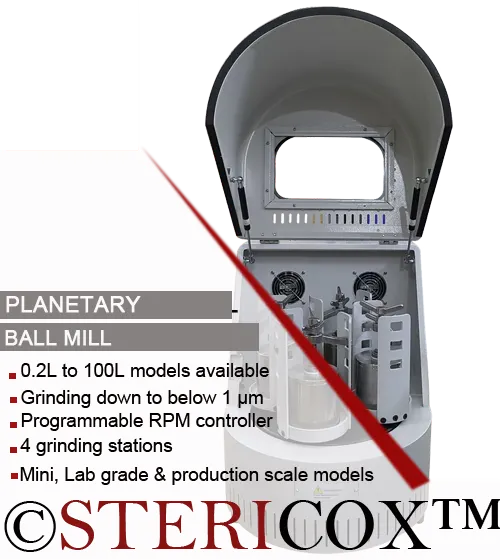
A planetary ball mill is a high-energy grinding machine used to pulverise, mix and homogenise powders and slurries. Grinding jars are mounted on a rotating base plate (the "sun wheel"). While the plate turns one way, each jar spins on its own axis in the opposite direction, much like a planet orbiting a sun. The balls inside are thrown across the jar and strike the sample with high impact and friction, which breaks particles down far faster than a conventional tumbling mill.
The same machine handles soft, medium-hard, very hard, brittle and fibrous samples, in either dry or wet mode, which is why it is a standard tool in materials, battery, ceramic, Metallurgy and pharmaceutical labs.
Features & Advantages of STERICOX Planetary Ball Mills
- Fine and fast grinding: particle size below 1 µm achievable, depending on sample and media.
- Dry and wet milling in the same machine.
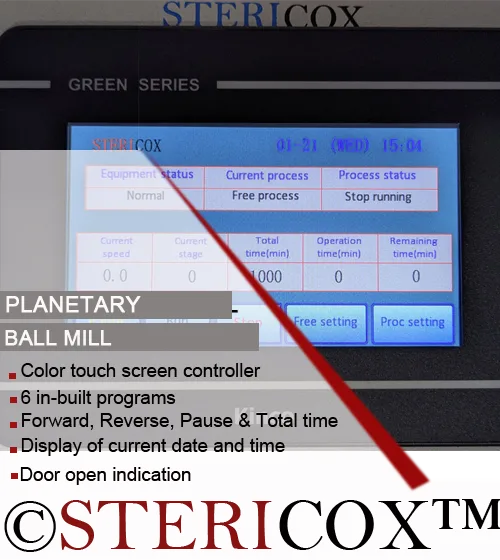
- Programmable controller: Color touch screen controller with 6 in-built programs to set forward run time, reverse run time and pause interval; total run time up to 9999 minutes.
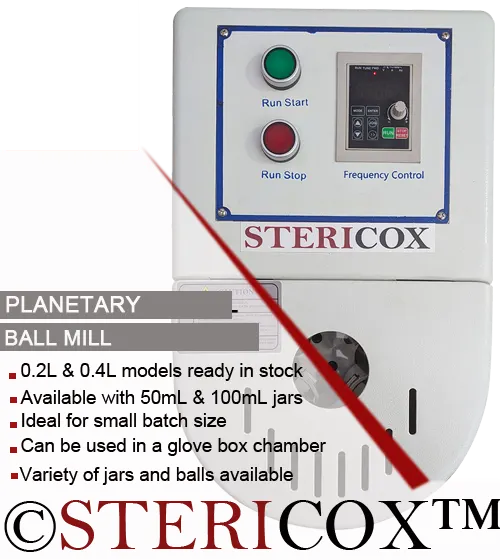
- Variable speed with a frequency (VFD) controller, from 40 rpm up to 870 rpm depending on the model.
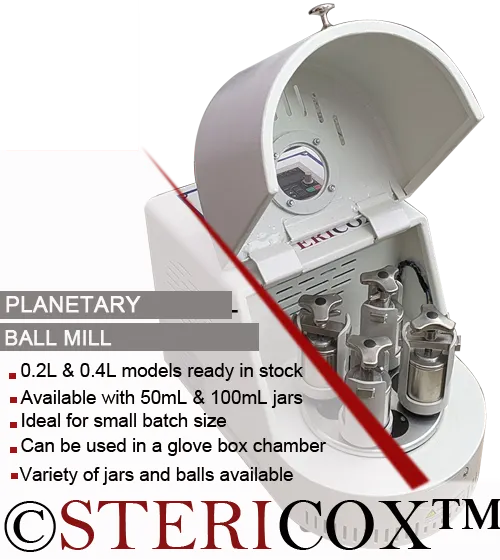
- Four jar stations, with 2 or 4 jars used at one time depending on sample volume.
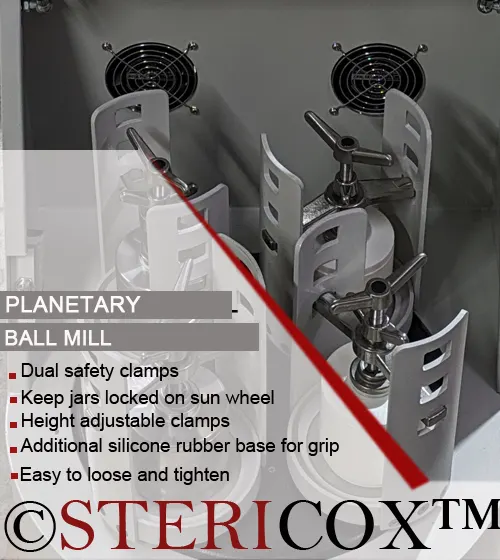
- Dual clamping that holds jars firmly and safely during high-speed operation.
- Heavy-duty gear and belt drive built for long, trouble-free operation.
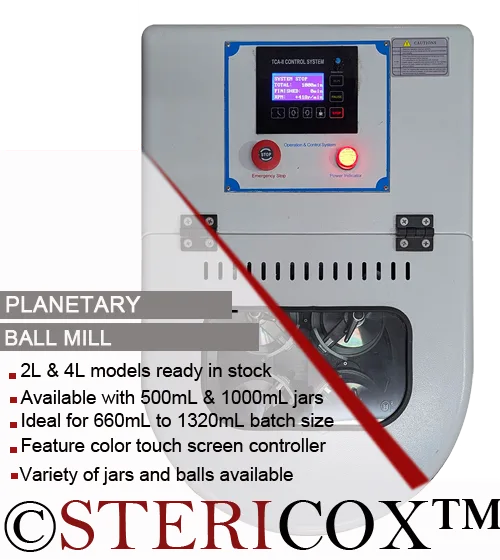
- Easy to operate and clean, with an ergonomic layout; pneumatic lid opening on larger models.
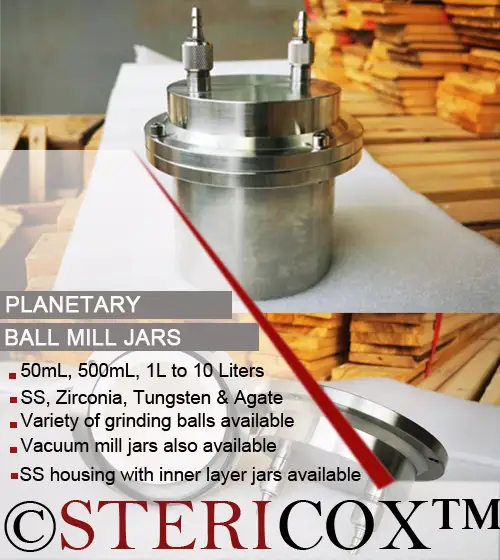
- Optional vacuum jars for oxygen-sensitive materials.
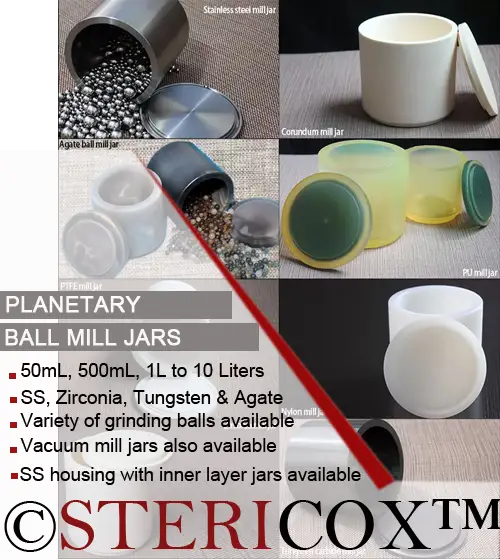
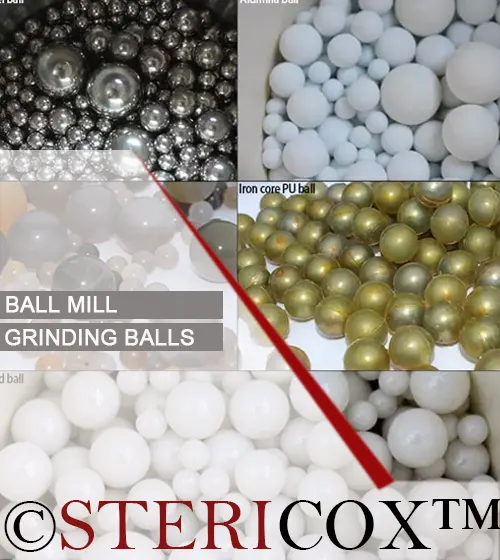
- Wide choice of jars and balls in seven materials (see below).
Planetary Ball Mill Models and Specifications
| Common Specifications for all models | |
| Number of Stations | 4 |
| Timer | 1-9999 minutes |
| Controller | Programmable RPM controller |
| Drive mechanism | Gear and belt drive |
| Feed size | ≤10 mm for soft and brittle material ≤3 mm for hard material |
| Output Size | Minimum output particle size <1 µm (material dependent) |
| Jars & Balls | Jars and bals (model dependent) |
| Optional | Vacuum jars |
| Benchtop Mini Planetary Ball Mill (0.2L and 0.4L) Ready in Stock | |||
| MODEL | CAPACITY | JAR | SPEED |
|---|---|---|---|
| STXPBM0.2 | 200 mL | 50 mL x 4 | 90 - 870 rpm |
| STXPBM0.4 | 400 mL | 100 mL x 4 | 90 - 870 rpm |
| Compact and quiet, these small planetary ball mills suit small samples and can fit on a lab bench or even can be used in a Glove Box. | |||
| Laboratory Planetary Ball Mill (2L to 4L) Ready in stock | |||
| MODEL | CAPACITY | JAR | SPEED |
|---|---|---|---|
| STXPBM2 | 2000 mL | 500 mL x 4 | 70 - 670 rpm |
| STXPBM4 | 4000 mL | 1000 mL x 4 | 70 - 670 rpm |
Planetary Ball Mill for Laboratory Use
| Production scale planetary ball mill models (Made to order) | |||
| MODEL | CAPACITY | JAR | SPEED |
|---|---|---|---|
| STXPBM8 | 8 L | 2 L x 4 | 70 - 580 rpm |
| STXPBM12 | 12 L | 3 L x 4 | 70 - 580 rpm |
| STXPBM16 | 16 L | 4 L x 4 | 60 - 510 rpm |
| STXPBM20 | 20 L | 5 L x 4 | 50 - 430 rpm |
| STXPBM40 | 40 L | 10 L x 4 | 40 - 390 rpm |
| STXPBM60 | 60 L | 15 L x 4 | 40 - 260 rpm |
| STXPBM100 | 100 L | 25 L x 4 | 40 - 240 rpm |
Planetary Ball Mill Price in India
Planetary ball mill price depends on a handful of factors. Understanding them helps you compare quotations on a like-for-like basis:
- Capacity and number of jars: a 0.4 L benchtop unit and a 100 L production mill are different classes of machine.
- Drive and motor rating: heavier gear, belt and motor assemblies cost more but run longer.
- Controller: programmable timer with forward/reverse/pause and a frequency (VFD) speed control.
- Jars and balls: these are priced separately. Stainless steel is the most economical; zirconia, agate and tungsten carbide cost more.
- Options: vacuum jars, extra jar sets, custom builds and installation.
As the manufacturer, we quote factory price with no middleman margin. Share your sample, batch size and jar material and we will send a quotation covering the machine, jars, delivery and installation.
Grinding Mill JARS AND COMPATIBILITY
| Jar and ball materials and what they suit | ||
| Material | Best for | Keep in mind |
| Stainless steel 304 | General-purpose, budget-friendly milling | Can contaminate sensitive samples with iron |
| Zirconia | High-purity work: ceramics, rare-earth powders, pigments, electronic pastes, pharmaceuticals | Costs more than stainless steel |
| Alumina | Minerals, ceramics and hard materials; chemically resistant | Less tough than zirconia |
| Tungsten carbide | Very hard samples: diamond powder, hard and magnetic alloys, silicon carbide, tungsten carbide | Expensive and heavy |
| PTFE / Nylon / PU | Acids, alkalis and aggressive chemicals; soft or sticky samples; easy cleaning | Not for very hard, abrasive material |
| Agate | Hard, brittle and fibrous samples; soil, rock, minerals, ores and geological samples | Not for extremely hard, dense material |
| Ceramic | Wear-resistant, low-contamination milling | Check compatibility with your sample |
Applications of Planetary Ball Mills
- Battery research: cathode and anode materials, solid electrolytes.
- Ceramics and glass: oxide powders, glazes, frits.
- Chemicals and pigments: dispersion, mixing and fine grinding.
- Electronics: conductive pastes, electronic ceramics, magnetic powders.
- Geology and mining: soil, rock, ore and mineral sample preparation.
- Pharmaceutical and food labs: homogenising and particle size reduction.
- Environmental testing: preparing solid samples for analysis.
- Mechanical alloying: Mechanical alloying and nano-material synthesis in materials science.
- Construction materials: cement and additive testing.
How to Choose the Right Planetary Ball Mill
Selecting the right model of a planetary ball mill may be a tough job for a new user. Below, we explain how you can choose the right machine:
- Start from your batch size. The maximum sample that can be placed in a jar is one-third of its volume. For example, in a 500 mL jar, a maximum of about 166 mL of sample can be ground easily. In addition, the combined volume of the sample and balls should be two-thirds of the jar’s volume. This will help you determine which jar volume is suitable for your batch size, and based on that, you can select the right model.
- Pick the jar material using the guide above, based on hardness and contamination tolerance.
- Decide dry or wet milling. Wet milling helps with very fine particle sizes and heat-sensitive samples.
- Check the speed range. Smaller jars reach higher rpm, which suits nano-scale work; larger jars run slower with higher throughput.
- Consider a vacuum jar if the sample oxidises or reacts with air.
- Plan for scale-up. If you expect to move from research to production, choose a lab model in the same series as a production unit.
Why Buy from Stericox
- Direct manufacturer in laboratory and light industrial equipment since 1978, so you deal with the maker, not a trader.
- Factory price with transparent quotations.
- Supply across India and export to Middle East Countries, Africa, Nepal, Bhutan, Bangladesh etc.
- On-site installation, commissioning and operator training throughout India.
- Responsive after-sales service and spare parts; service available throughout India
- Trusted by research and industry users including IIT, NIT, Universities and other private and Government organizations.
- Customisation of capacity, jar configuration and controls.