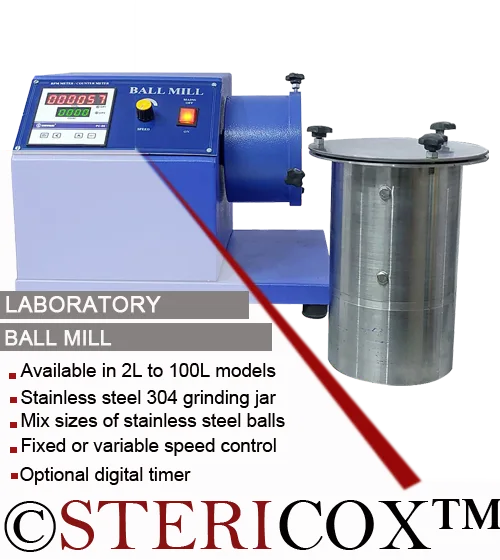
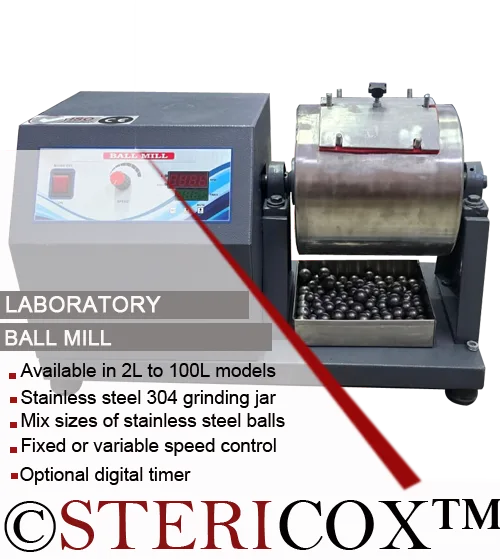
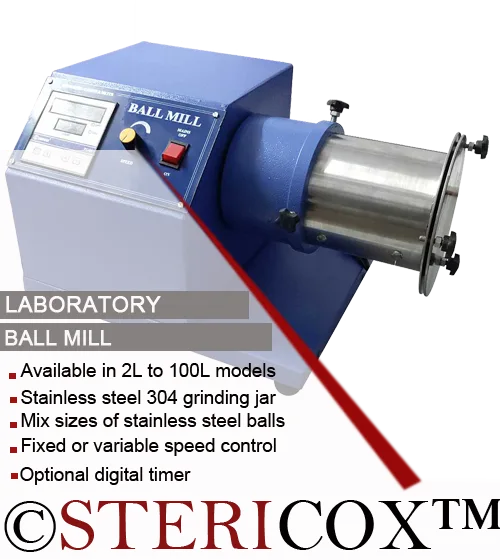
How the laboratory ball mill works
The sample and a charge of stainless steel balls are placed inside the stainless steel jar. As the jar rotates in one direction, the balls tumble and cascade, crushing and rubbing the material until it reaches the fineness you need. Longer run times and different ball sizes give you control over the final particle size.
Where ball mill is used
Laboratory ball mills are commonly used for sample preparation and R&D in:
- Ceramics and glass
- Paints, inks, pigments and coatings
- Chemicals and minerals
- Pharmaceutical and cosmetic raw materials
- Metallurgy and materials testing
- University and research laboratories
FEATURES & ADVANTAGES
- Four jar capacities: 2, 5, 10, 20, 50 & 100L.
- Stainless steel 304 grinding jar.
- Stainless steel balls of mix sizes for efficient grinding.
- Powder-coated mild steel body for a sturdy, long-lasting frame.
- Simple, dependable operation with a standard ON/OFF switch.
- Low-maintenance mechanical design for years of routine use.
- Runs on a standard 220-230 V, 50 Hz single-phase supply.
- Easy to clean and resistant to contamination between batches.
TECHNICAL SPECIFICATIONS
| MODEL | Capacity | Jar dimensions (Dia.*L) | RPM | Feed Size | Output Size* |
|---|---|---|---|---|---|
| STXLBM2 | 2L | 125*225 mm | 20 – 60 | ≤ 10 mm | >70 Micron |
| STXLBM5 | 5L | 200*200 mm | 20 – 60 | ≤ 10 mm | >70 Micron |
| STXLBM10 | 10L | 225*250 mm | 20 – 60 | ≤ 10 mm | >70 Micron |
| STXLBM20 | 20L | 300*300 mm | 20 – 60 | ≤ 20 mm | >70 Micron |
| STXLBM50 | 50L | 400*450 mm | 20 – 60 | ≤ 20 mm | >70 Micron |
| STXLBM100 | 100L | 450*700 mm | 20 – 50 | ≤ 20 mm | >70 Micron |
| Jar construction | Stainless Steel 304 | ||||
| Balls | Mix size balls of stainless steel | ||||
| Speed mode | Fixed | ||||
| Motor | Heavy duty AC motor | ||||
| Hosing | Heavy duty powder coated MS angled frame | ||||
| Power supply | 220-230V/50Hz | ||||
| Optional |
|
||||
| *Output size is material dependent. Sample to balls ratio and grinding time also play important role in final output size | |||||
Frequently asked questions
- What does the 2/5/10/20/50/100 L rating mean?
It is the jar’s overall volume; based on density of the material convert weight into litres to select the suitable model. - What maximum sample volume can be grind in the ball mill?
Ideally 35% of the jar volume is the maximum load can be grind in the ball mill; for example 10L is suitable for 3.5L sample load. - What is ball to sample ratio?
5:1 to 10:1 is the ball to sample ratio for most of the material; for example 5Kg to 10Kg balls required for 1kg sample grinding. (note: harder the material larger the balls needed) - Can the mill grind wet samples?
Above models are intended for dry powder grinding and mixing. Contact us if your application involves wet milling. - Can I add a timer or speed control later?
Yes. Digital timers, speed regulators and revolution counters can be specified at order stage. Ask us about retrofitting. - Do you supply custom sizes or materials?
Yes. Tell us your sample type and batch size and we will propose a suitable configuration. - Do you deliver across India and export?
Yes, we supply ball mills throughout India and export to middle east countries, Africa, Malaysia, Philippines, Vietnam, Nepal and Bhutan etc. - What is laboratory ball mill price in India?
The price of a laboratory ball mill varies from model to model and according to the accessories supplied. Discuss your requirements with us, and we will provide you with a quotation based on your needs.